Exorcism! by Peter Underwood
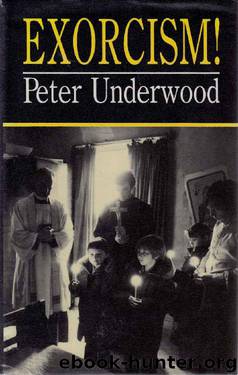
Author:Peter Underwood [Underwood, Peter]
Language: eng
Format: epub
Published: 2018-05-24T23:00:00+00:00
5. Exorcism and Witchcraft
The late Ronald Seth once told me that his researches into witchcraft had resulted in his acceptance of an ancient cure for bewitchment - by white magic: 'If a child is bewitched, take a candle and throw it three times through an enchanted hoop, ring or belt, and then a dog must throw it and then shake the belt over a fire; then throw it down on the ground and leave it there until a dog or a cat walks over it; and sickness of all kinds will leave the person and enter the dog or cat I dare say it is as good an exorcism as many another.
On actual exorcism in respect of witchcraft, he was in favour of simple Christian exorcism: 'Fix your eyes firmly on the afflicted person and, laying a hand on his or her head, call upon the devil who is the originator of evil; make the sign of the cross over the affected person and urge the devil to depart, saying: “In the name of Jesus Christ I command you, unclean spirit, if you hide in the body of this man [or woman or child] created by God, if you vex him [or her] in any way, at once give me some sign of the certainty of your presence in this child of God, which until now in my absence you have been able to do as you and your master wish." If some sign is accepted as evidence of the presence of an evil spirit, the exorcist calls upon the almighty power of Jesus Christ and commands whoever is vexing the bewitched person to, "Go hence, nor pester or annoy or trouble this person or anyone here present from this moment forward - Go now!" '
Such exorcisms or something like them have a long history. St Paul is said to have exorcized evil spirits in the name of the Father, Son and Holy Ghost. In the New Testament a comparable formula is to be found in St Matthew, but here it is generally regarded as a doctrinal expansion of some simpler form, such as 'in my name', the speaker being Jesus himself; for there is no hint of such a formula elsewhere in the New Testament.
In the Middle Ages devils and demons and Satan himself were very real and ever-present beings. Much of the literature of the period shows traces of monks' and nuns' and other pious persons' preoccupation with the doings of Satan and his angels. It can be argued that primitive peoples were less concerned or aware of such matters, although it cannot but be accepted that the monastic conceptions of the Devil, his followers and his works had definite roots in earlier beliefs.
Dr G.G. Coulton, who was regarded as possessing an unsurpassed knowledge of the Middle and Dark Ages, has shown in his book. Five Centuries of Religion, that this intense and overwhelming belief in the power of demons was due to the fact that during the
Download
This site does not store any files on its server. We only index and link to content provided by other sites. Please contact the content providers to delete copyright contents if any and email us, we'll remove relevant links or contents immediately.
| Ancient & Controversial Knowledge | Ghosts & Hauntings |
| Hermetism & Rosicrucianism | Magic Studies |
| Occultism | Parapsychology |
| Supernatural | UFOs |
| Unexplained Mysteries |
Animal Frequency by Melissa Alvarez(4471)
Sigil Witchery by Laura Tempest Zakroff(4243)
Real Magic by Dean Radin PhD(4128)
Fingerprints of the Gods by Graham Hancock(4004)
Aleister Crowley: The Biography by Tobias Churton(3640)
Journeys Out of the Body by Robert Monroe(3624)
Alchemy and Alchemists by C. J. S. Thompson(3520)
The Rosicrucians by Christopher McIntosh(3519)
Mysteries by Colin Wilson(3454)
Hitler's Monsters by Eric Kurlander(3342)
The Hatha Yoga Pradipika (Translated) by Svatmarama(3342)
Wicca: a guide for the solitary practitioner by Scott Cunningham(3178)
John Dee and the Empire of Angels by Jason Louv(3165)
Infinite Energy Technologies by Finley Eversole(2984)
Book of Life by Deborah Harkness(2939)
Dark Star Rising by Gary Lachman(2866)
The Book of Lies by Aleister Crowley(2846)
Aliens by Jim Al-Khalili(2829)
To Light a Sacred Flame by Silver RavenWolf(2823)
